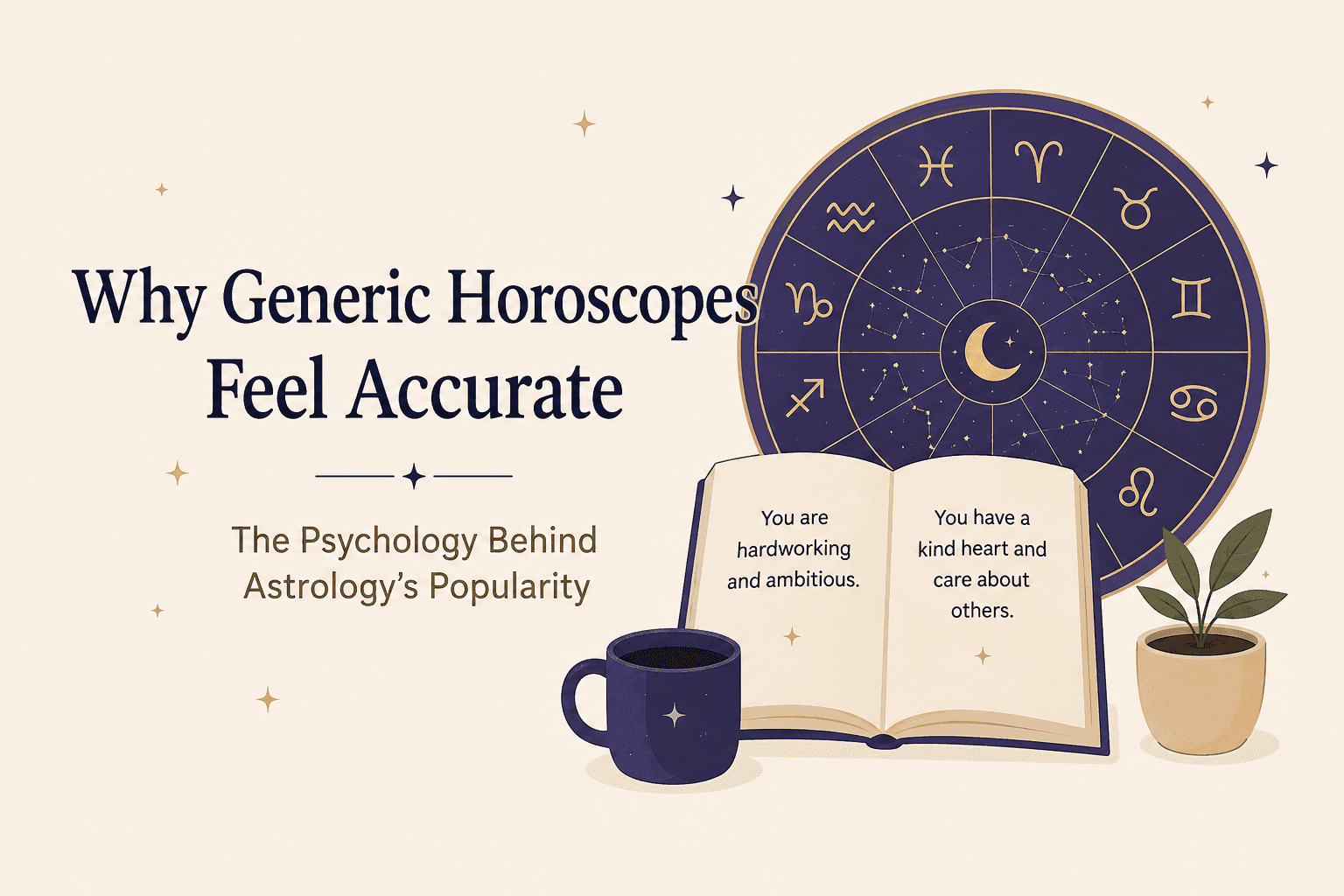
Why Generic Horoscopes Feel Accurate: The Psychology Behind Astrology's Popularity
Have you ever read a horoscope and felt like it described your life perfectly? Whether it's a prediction about your relationships, career, or emotions, many people find themselves connecting deeply with astrology. But what makes these broad statements feel so personal?
The answer lies at the fascinating intersection of psychology and human behavior. While astrology has been practiced for centuries, modern psychology offers interesting insights into why horoscopes resonate with millions of people worldwide.
The Barnum Effect: Why We See Ourselves in General Statements
One of the most well-known psychological explanations for astrology's appeal is the Barnum Effect. This phenomenon occurs when people believe that vague and general personality descriptions are uniquely applicable to them.
For example, statements like:
"You sometimes doubt whether you've made the right decision."
"You value close relationships but also need personal space."
"You have untapped potential that others don't always see."
These descriptions can apply to almost anyone, yet they often feel deeply personal. Horoscopes frequently use this technique, making readers feel understood and validated.
Confirmation Bias: Remembering the Hits, Forgetting the Misses
Another psychological factor at play is confirmation bias. Humans naturally tend to notice information that supports their existing beliefs while ignoring information that contradicts them.
Imagine reading a horoscope that predicts an exciting opportunity. If something positive happens during the week, you'll likely remember the prediction and consider it accurate. However, if nothing significant occurs, you may simply forget about it.
This selective memory strengthens our belief in astrology's accuracy over time.
Astrology as a Tool for Self-Reflection
Despite the psychological explanations, astrology's popularity isn't solely based on cognitive biases. Many people use astrology as a framework for self-reflection.
Reading about personality traits, strengths, weaknesses, and life challenges can encourage individuals to think more deeply about themselves. In this sense, astrology functions similarly to journaling, personality assessments, or reflective exercises.
Even those who don't fully believe in astrological predictions often find value in the questions and insights astrology encourages them to explore.
The Digital Age and Astrology's Resurgence
Interestingly, astrology has experienced a major revival in the digital era. Social media platforms are filled with horoscope content, birth chart analyses, and zodiac memes that attract millions of users daily.
Several factors contribute to this trend:
Accessibility
Astrology apps and websites make personalized readings available instantly.
Community
Online astrology communities allow people to connect through shared interests and experiences.
Search for Meaning
In a fast-paced and uncertain world, many individuals seek guidance, comfort, and a sense of direction. Astrology often provides a language for discussing emotions, identity, and life transitions.
Birth Charts vs. Daily Horoscopes
Many astrology enthusiasts argue that birth charts offer a more detailed and individualized experience than generic sun-sign horoscopes.
A birth chart considers:
Date of birth
Time of birth
Place of birth
These elements are used to create a complex map of planetary positions, resulting in a more personalized interpretation. Whether one views astrology as science, spirituality, or entertainment, birth charts often feel more specific than daily horoscope predictions.
Why Astrology Continues to Thrive
The enduring appeal of astrology may not be about predicting the future. Instead, it often fulfills emotional and psychological needs.
People turn to astrology because it can:
Provide comfort during uncertainty
Encourage self-discovery
Create a sense of belonging
Offer hope and perspective
Spark meaningful conversations
Regardless of belief, astrology remains a powerful cultural phenomenon because it speaks to something fundamentally human—the desire to understand ourselves and our place in the world.
Conclusion
The accuracy of generic horoscopes may be influenced by psychological principles such as the Barnum Effect and confirmation bias. However, astrology's popularity extends beyond these explanations.
For many, astrology serves as a tool for reflection, connection, and personal growth. Whether you see it as entertainment, spirituality, or a source of insight, its lasting influence highlights humanity's ongoing search for meaning and self-understanding.
Perhaps the real magic of astrology isn't in predicting the future—it's in helping us better understand ourselves.